Know what is worth keeping
Mature shade, mast producers, boundary trees, and road screening all have real value. Flag them and we clear around them.

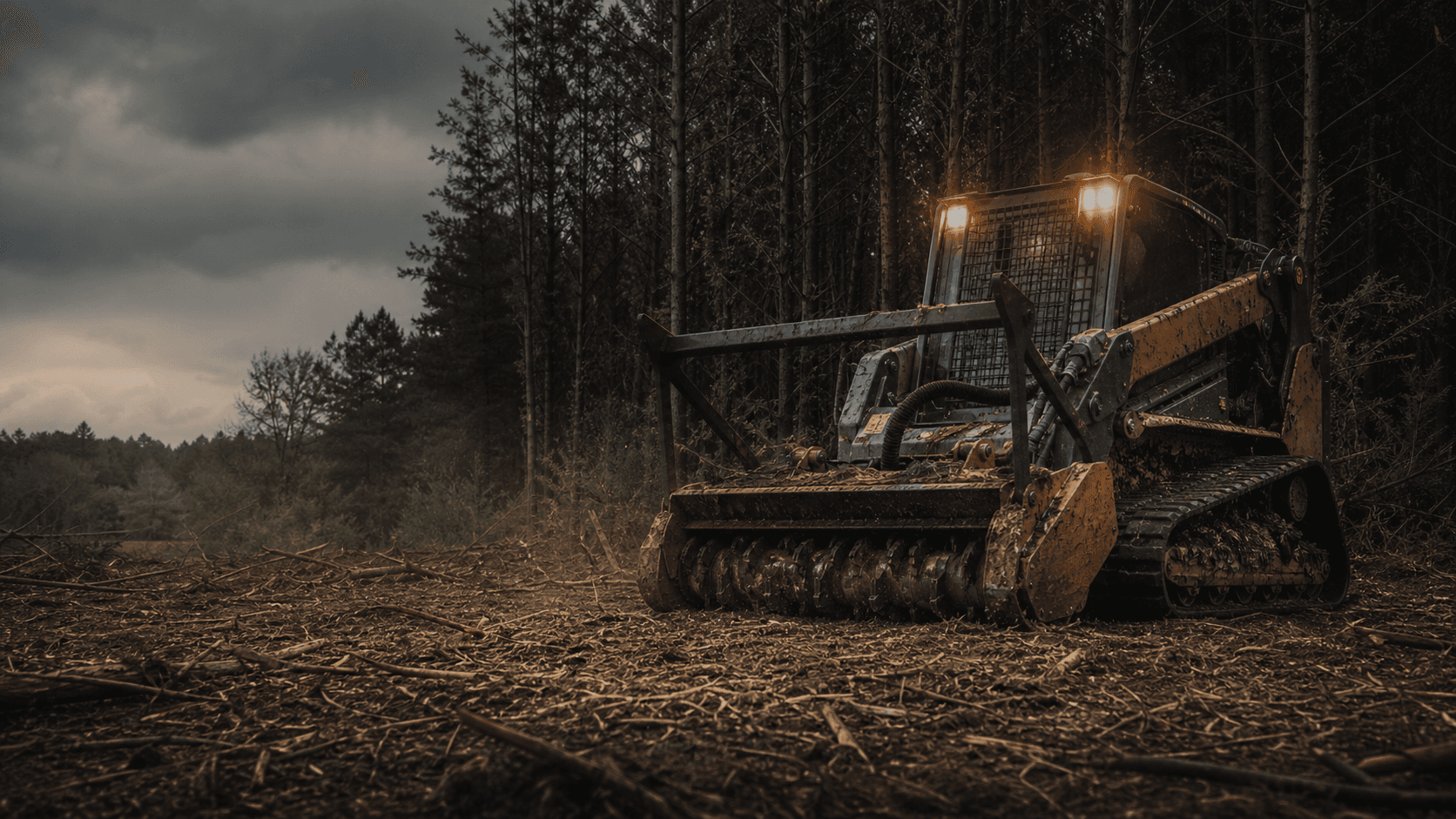
CULLMAN, AL · CULLMAN COUNTY
Reclaim overgrown acreage, open trails and homesites, and clear brush, saplings, privet, and honeysuckle — without burn piles, hauling, or stripping your topsoil. Owner-operated out of Cullman.
Cullman Land Clearing uses forestry mulching equipment to remove dense brush, invasive vegetation, saplings, and selected small trees from rural property in Cullman County and the surrounding North Alabama counties. We reclaim overgrown acreage, open trails and access routes, prepare homesites, improve food plots, and knock back privet and honeysuckle — while leaving the mature trees worth keeping standing.
YOUR LAND. YOUR PLAN.
Brush, small trees, and rough access can keep good acreage from being useful. Across Cullman County, the culprit is usually the same: Chinese privet and Japanese honeysuckle taking the understory a few feet a year until the back of the property is gone. You need someone who understands the work, listens to the actual goal, and clears the next step forward.
See how we clear landARBORIST-INFORMED LAND CLEARING
We plan clearing around the property you want to keep using—so the scope can account for the trees worth preserving, the growth holding the property back, and the way you want the land to develop.
Mature shade, mast producers, boundary trees, and road screening all have real value. Flag them and we clear around them.
Target invasive and unwanted growth—privet, honeysuckle, autumn olive—around the access, visibility, and future use you need.
Clearing the whole tract is the most expensive version of most projects and rarely the one that makes the property better.
WHAT WE HELP YOU OPEN UP
One machine grinds standing brush, vines, and small trees into a mulch layer on site. No burn piles, no hauling.
Open up acreage for access, safer use, and the next stage of your property plans — scoped to the finished use, not just the removal.
Get a homesite, barn site, or driveway approach opened up and visible — the vegetation stage of site prep, scoped honestly.
Trails, shooting lanes, food-plot ground, and access on the property you already own — cleared around the way you hunt it.
Linear clearing along boundaries, fence rows, easements, and access trails — priced by the foot and the width, not by the acre.
WHAT YOUR PROPERTY COULD BECOME
Every property is different. These are illustrative scenarios—not customer projects—showing the kind of access and usable space forestry mulching can help create.
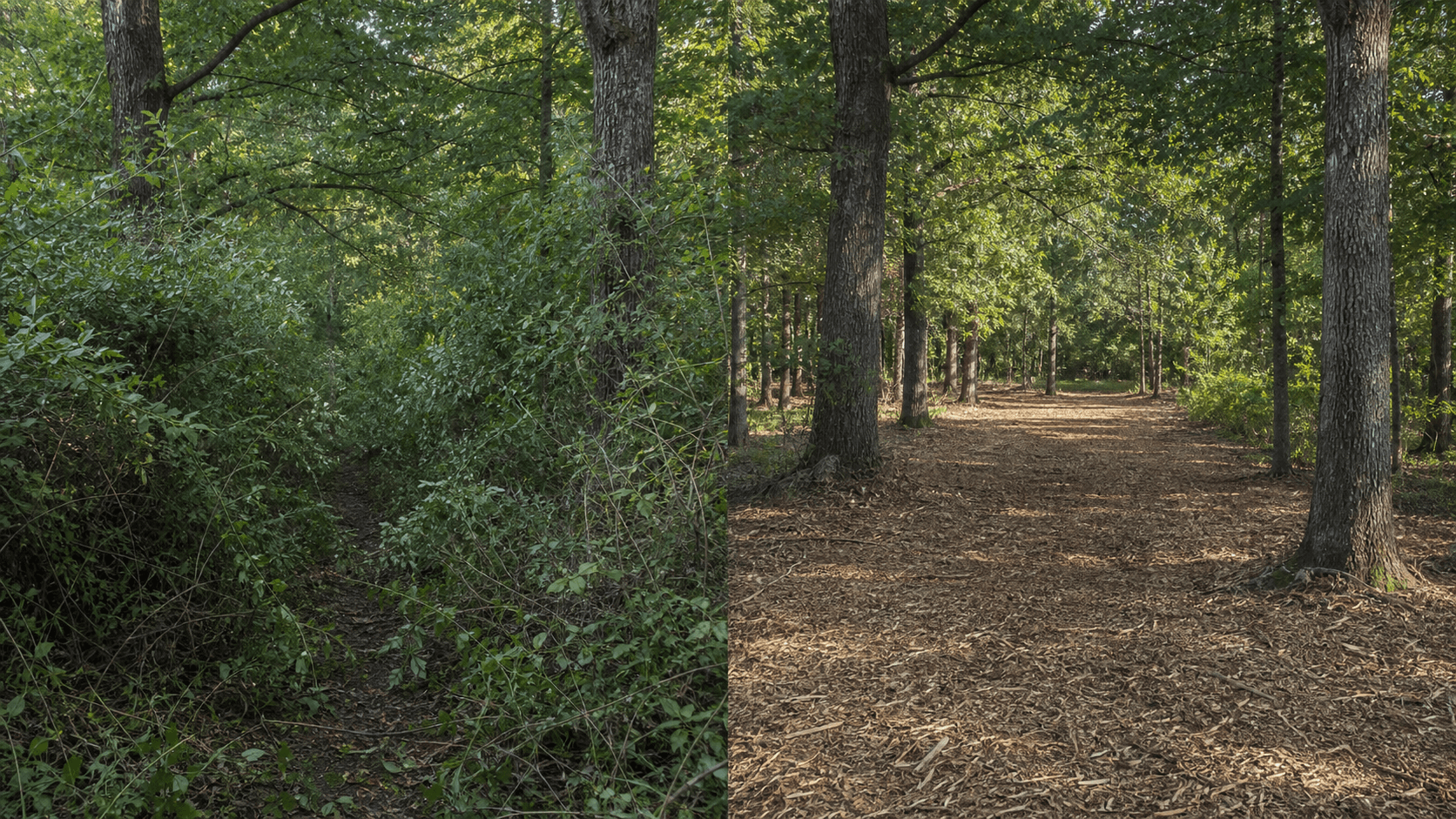
Open a trail and improve sight lines while retaining the mature trees that make the property worth owning.
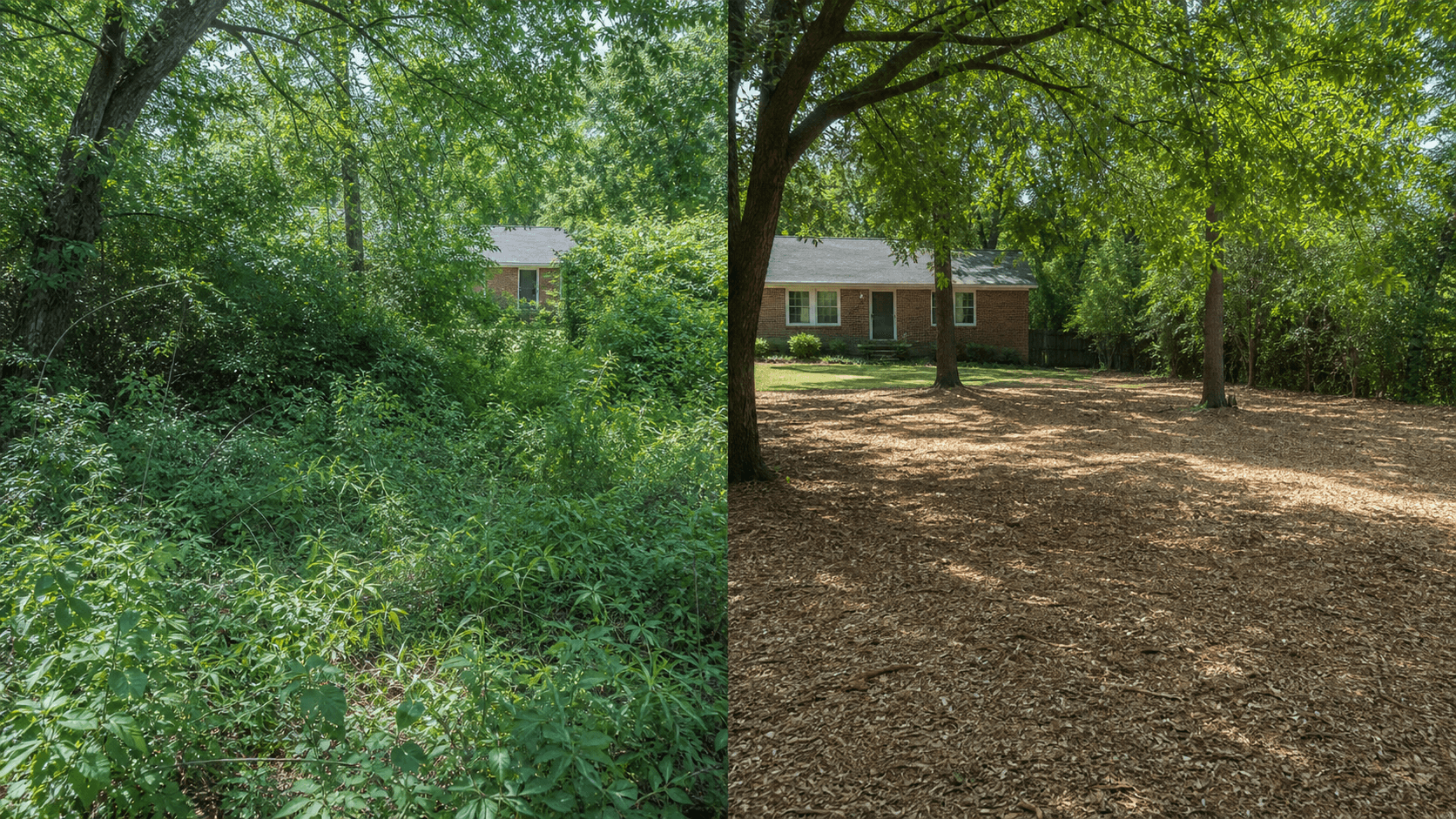
Clear heavy brush and volunteer growth so your property feels manageable again—without stripping away the shade trees.
A SIMPLE WAY FORWARD
There is no mystery around what comes next. We start with your property, your priorities, and the work needed to make the ground usable.
Share the acreage, vegetation, and the outcome you need. You get a planning range immediately.
Free, and it is where the range becomes a price — and where wet crossings, buried wire, and real stem density get found before they cost anybody money.
Area, what goes, what stays, mulch depth, stump height, and what is not included. No surprises on the day.
We price in quarter-acre increments: $575 per quarter acre, or $2,300 per acre, on light brush over flat ground. Two things move that number, and we price them separately so you can see what is driving the cost—brush density (up to 1.3x for dense growth) and terrain (up to 1.25x for steep slope). Stacked together, most rural North Alabama property lands between $2,300 and $3,700 per acre. There is a $1,600 project minimum that covers up to half an acre, adjusted by those same two factors, because moving equipment onto the property costs the same whether we clear a quarter acre or three. Acreage rounds up to the next quarter acre. Difficult equipment access adds time to a job, but we scope that on the property instead of charging a blanket surcharge for it. These are planning ranges, not quotes.
Forestry mulching cuts stems at or near ground level and grinds the material into a mulch layer across the site. It does not extract stumps or root balls—those stay in the ground, cut low. Expect a mulch mat a few inches deep, low residual stumps, and a surface most tractors and utility vehicles can cross, though a first pass with a mower may still find high spots in the first season or two. Larger material that will not process cleanly gets stacked rather than scattered, and we will tell you where before we start. If you need a true clean, stump-free grade, that is excavation work and a separate scope. The most common regret we hear about mulching comes from expectations nobody wrote down—so we put the finished result in writing on the estimate.
Production ranges from roughly two to four acres per day in light brush and saplings down to well under an acre per day in heavy, mature growth. Density drives almost everything—a property neglected for thirty years can take five times longer per acre than one bush-hogged a few seasons ago. Slope, wet ground, obstacles, tree size, and how clean a finish you want all pull the rate down. Because of that spread, we walk the property before committing to a schedule. Most residential and small-acreage jobs finish in one to three days once we are on site.
For most private rural clearing, the useful distinction is this: cutting vegetation is generally allowed, while disturbing soil is what tends to trigger permitting. Mulching leaves the root mat and soil largely intact, which keeps many projects out of the permitting path that grading and excavation fall into. Requirements still depend on your property. Work near a creek, wetland, or river can fall under streamside protections and federal wetland rules, land disturbance tied to construction can require state stormwater coverage, and your county may have its own grading or erosion requirements. Before work starts we walk the property with you, identify anything close to water, and confirm what your specific project needs with the county rather than guessing.
CULLMAN-BASED. CULLMAN COUNTY FIRST.
We are based in Cullman and Cullman County is home. Travel is not a meaningful cost factor anywhere inside it.
Outside Cullman County, travel becomes one of the inputs in the estimate — a line item we show you rather than bury in the per-acre rate.
START WITH THE PROPERTY
Acreage, vegetation, and access is enough. Owner-operated · Insured · Based in Cullman, AL · Free onsite estimates.
Owner-operated · Insured · Based in Cullman, AL · Free onsite estimates